Tuesday, 27 June 2023

Productive Evenings - Greenhouse Design & Getting Tidied

The weather has been crazy hot after a very slow and cold start to the year.  We've seen in the longest day/shortest night now that we're officially in to summer.  The evenings are long and not much cooler than the day time however we have so much to do that needs must.

Steven has been busy clearing the space at the back of the greenhouse.  This is a climbing plant, not sure what variety, that takes over very quickly.  It's stopping a lot of light in the back corner of the greenhouse so clearing it will offer big benefits.  The sun was going down as he finished the task and it was a beautiful night.  


Over the last week, we have worked very hard to get the greenhouse in to a place we are happy with.  Up until now, we have used pots in there every year to grow tomatoes and so on.  This is very time consuming for watering and things quicky dry out.  We've cleared the back greenhouse out and have put raised beds in there - much easier for watering so I hope for a bountiful crop this year!


The contents of the greenhouse were moved to the shed, to tidy at a later date.  Something I've been putting off!  I've finally got round to clearing it out and I am so pleased that it is a useable space again.  I hated not being able to use it, almost as much as tidying it out!


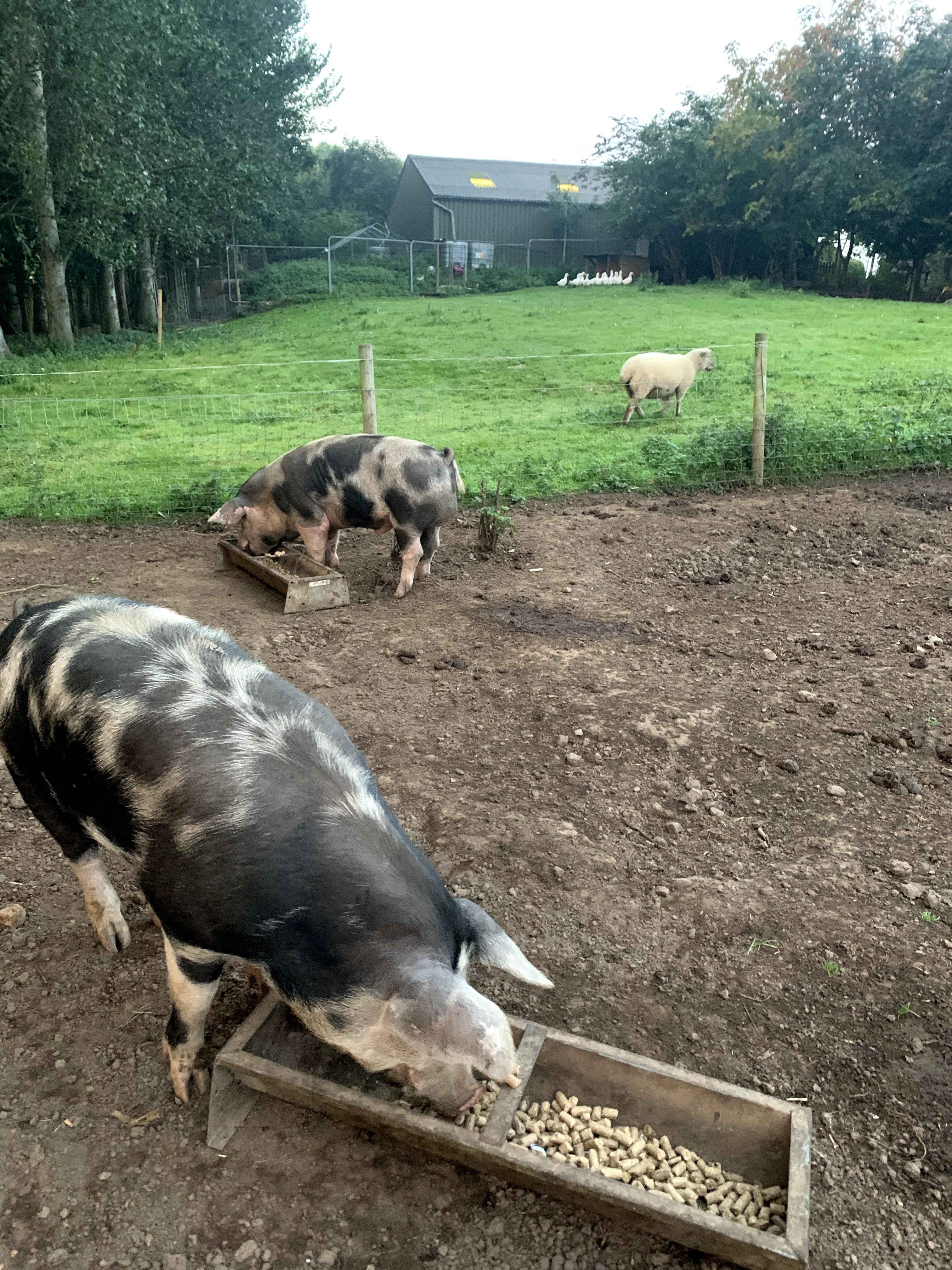
We finally then got some rain.  It didn't last long, but it certainly let itself be known when it was here.  The pigs will make short work of their new ground now it's a bit wet again.


Friday, 28 April 2023

Last few days in April

Welcome to the last few days in April.  Here in the NE of England it continues to be changeable weather, raining again as I type this, and the nights are low, single digits.  I’m longing for long, warm, “lazy” days as I’m sure the plants are too and I know the animals will be just as grateful for drier ground.  I’m trying not to panic that things aren’t as far on as my mind sometimes thinks they should be.  I know that’s a common worry for gardeners when you see other people’s updates.  There’s plenty of time yet for a lot of things, some seeds shouldn’t even be sown for my climate at this point in the year. 

April showers bring May flowers though I don’t remember so much rain and cold in April recently, however I tend to forget.  Around here, the farmer next door has had his cows out to pasture for a couple of weeks now.  


We normally time the horses going out around the same time, however not this year.  Our horses haven't been in the field at all over winter as we rest the land.  They do get out as you know, only on the hard standing outside the barn otherwise they would break a leg or ruin the land.  It's too slippery for them and us, so we're monitoring it daily, fingers and toes crossed that the rain lets up after this weekend, which the forecast does imply.

We're also consistently seeing low night time temperatures which will continue in to next week, although now quite as low as the last few nights (0-2c), they'll be around 3 or 4c for a while yet.  That's not warm enough for the plants to grow strongly and I'm waiting in anticipation for those warmer days.


Having said that, we have some strong looking brassica plants that I moved to the cold frame this week, purely to make space in the greenhouse as I must get the remainder of April sowings done before we move into May.  The courgettes, summer squash and winter pumpkins along with the cucumbers can be sown in the North East now.  You can sow them earlier, but they grow rapidly and earlier sowings mean I would have to tend to them in the greenhouse for longer, potting them on until after the last frost date which is a month away yet.


I noticed on my walk this week that the elderflowers are thinking about making an appearance.  Elderflower season is May and early June here for us and a season I love, so won't be missing that.  Back from my walk, I checked on the honesty stall, to make sure the eggs that are out are ok and the tin is there for any pennies people leave.  I plan on adding rhubarb and veggie plants there from this weekend.  All proceeds go towards the animal feed, which as I keep saying, has flown up in price.  I’m making sure we have fresh eggs every day for people.

 
Plans for the weekend are vast as always and no surprise the weather isn't looking too kind, however there may be just enough sun on Saturday morning for the dandelions to make an appearance, allowing me enough time to collect them and make the dandelion honey I love to make.  If we're rained off that (they only display in the sun), then I also want to process more rhubarb and make the Wild Garlic oil paste as the wild garlic is moving in to its next stage and forming flower buds, so before it does that with vengeance, I need to make the paste then will pickle some buds.

I'll plan on planting out the brassicas that are in the cold frame, though I do need to protect them from cats as they keep using my veg beds as a toilet and I'm not impressed.  I'll double up the protection so it's a butterfly protector too, saves me having to change it when that season comes round.

Let’s see what it has in store for us!  I hope it’s a good one for you.

Tuesday, 25 April 2023

Seasonal eating & Rhubarb chat

I continue to work towards seasonal eating as an all year round skill for my family.  A funny choice of word to call it a skill?  I think that's right though as it's something you learn to do in this day and age, when everything is available all of the time and it's almost an entitled feeling in society to have fresh strawberries in Winter.

Here on the smallholding, we aren't exempt from doing this and can buy blueberries in January and have banana pancakes that have travelled goodness knows how far on any day of the year.  Don’t get me wrong, we do eat seasonally (I’ll include using our home preserves out of season and the Winter Stores of veg in that) but we don’t have food growing 365 days of the year, which we could, given where we live in the North East of England.

After a few years of trial and error, with learning along the way, that’s my immediate goal which I am stepping up my actions to be able to achieve it.  Does that mean we won't eat bananas? No, but moving in to the remainder of 2023, I'll be aiming for the 80/20 rule in that 80% of our intake is local and seasonal.

In theory I could be harvesting much more from the garden now.  In 12 months and that sentence will be redundant ;) For now we are buying a weekly veg box from the local greengrocers which supports our local small business and more.  It's a beauty of a box.  I get the £25 one which is a bumper amount of fruit and veg.  Not everything in it is local, but that’s not an issue.  I’ve decided that although the box may be too much to get through every week, it will give us some things to preserve in small batches, if there’s a chance they won’t get used timely, which I am very pleased with.


So veg box aside, I’m starting my home grown seasonal eating mission off with the humble and potentially underrated Rhubarb.
  There’s a wealth of recipes that are out there on the interweb, some traditional, some more ‘creative’ .  From now through until June I will be trialling many of them.  I'll post on here as well as my social media channels if you're interested.


A little bit about rhubarb then.
  A rampant perennial and yes, it’s leaves are mildly toxic but perfect to compost (or use as a mulch to keep weeds down), it requires little attention once it’s got its roots down.  Don’t harvest during the first full year of growth but after that, harvest during the peak seasons by twisting the stalk at the base and pulling.  Don’t cut rhubarb stalks, twist them.  Cutting could encourage rot of the plant and make it ill.  Cutting it also leaves some of the stalk on the plant so it doesn’t know the stalk has gone and will not encourage new growth to replace what it has lost.

I plan on making the usual culprits, crumble (just has to be done), cordial / syrup as a drink, bottled as chopped fruit, poached or stewed and jarred for the winter, as a country wine, dehydrated, in pies, cobblers and muffins.  Not to forget as vinegar, in recipes like pavlova or shortcake and also as an apple sauce, where I'll puree it and interchange it with apple sauce on our roast dinners.  There's plenty more which I'm looking forward to doing.  Our rhubarb has grown rampant in previous years, so I'm hoping for the same this year!

Monday, 17 April 2023

Sunday 16th April - Day 1 Eve

Quick note - going forward, some of my posts will be in the form of diary inserts, which I may or may not turn in to a podcast or book.  Other posts won't be diary style.  I'll include the date like below when it's a diary style.

Sunday 16th April.

It’s the eve of day 1 and we have enjoyed a meal cooked over the fire outside in the newly built kitchen & seating area.  Wood foraged from our own trees and food from our land was enjoyed by all.  I’ve a lot to do to get ready for Monday, tomorrow.  Starting as I mean to go on and to make the mornings easier, I try to be as organised as I can the night before.  My evening routine involves cooking the family meal, clearing away with everyone’s help before having some time to digest our meal whilst we play darts or cards, if the weather allows.  This time of year, and what this paragraph’s opening Day 1 refers to, is the turning of the page to the Spring Chapter, which amongst other things includes evening meals outside.  This year, now we have the outdoor cooking space, I will be transitioning most of the kitchen necessities to outside allowing me to appreciate being outdoors to cook and eat. 


Once we have enjoyed our meal, which as the year marches on, will include more and more produce from the garden, we set about filling the animals’ water and checking on them before bed.  The lambs, who are on bottled milk have their last one of the evening, as late as possible before we put them in the safety of a stable (whilst they’re still small).  That means someone will have to head back over to the barn to do that later.  I set about filling up buckets of feed ready to just pick up and carry to eager mouths the following morning.  Anything to make the morning’s go smoothly helps.


Today there was a nip in the air this morning, but as I wandered over to the barn to do my share of the chores, I notice the air had warmed up somewhat.  It’s been terribly cold again lately and oh my, the rain!  Let’s just not go there.  I saw my first wasp of the year today.  I wish I could say I liked wasps, but they give me the jitters, especially at the beginning and end of the season when they always seem angry and aim right for you.

Once the animals are tended to, for the second time of the evening as they have their supper around 5:30, we say goodnight to them and either sit outside some more or head in.  The pots from our own supper are seen to and returned to the outdoor space.  In the main kitchen, it’s a quick whip around to get it ready for the morning, lunch boxes out, kettle filled, ingredients set out for breakfast.  In the UK, it’s far too chilly to sit outside for breakfast at this time of the year, even for the stoic of us.  Time for a hot drink before a shower and bed.  Goodnight.

Forager's Pantry, Easter and Planning

A quick note...

For a few week's prior to the Easter holidays I've been doing weekly podcasts which are snippets of life on the smallholding.  They're fairly easy for me to do as it's recorded directly on to my phone which I always have with me.  Here's a link if you're interested.  

Alongside this I'm working on weekly garden updates on YouTube  - all things related to growing our own food on the self sufficient journey.  I'm enjoying doing those and the content will naturally develop as the year gets underway as I cook & preserve more from the garden.

My cost of living video series will come to an end as May starts, so I am giving some thought as to the type of videos we will be putting out on YouTube once that is underway.  Easter is always the start of Chapter 2 in the year for me.  The New Year, rest and recharge is the first and I feel that I have done that and am ready to emerge with the fresh Spring shoots.  Even my painful hip is feeling better :) .

As is usual, I have had 2 weeks off work over Easter, giving me time to unwind, catch up with a few things and get ready for the next 11 weeks which will take us up to early July and doing the same again for the Summer chapter.

I'm also looking to build on the foraging I started last year and create a Forager's Pantry.  The Wild Garlic is in abundance and I'll share what I do with this in a dedicated post, however it's an essential item for my pantry in preserved form just in case the garlic bulbs fail or I have a gap in stores whilst I wait for them to grow.  Dandelions this coming week too!

As well as this, I'm interested in making foraged tinctures and powders to benefit from.  Something I've never done before, so will be learning along the way.  

So as I start this next chapter, today being day 1, I'd like to wish you well and encourage you to join me.  As a side note, I'm back updating on blogger from WordPress as I couldn't justify the costs to keep my own domain and hosting after the trial had ran out.  It was also far too time consuming to use it as it needed more attention that I was able to give!


Monday, 19 October 2020

A year's worth of meat (pork this time) plus a few hints and tips.

Hi everyone - today I want to talk you through the thoroughly exciting experience we have had with the pigs and hope to share with you what we have learned along the way.  We've had lots of lovely questions on various social media platforms so wanted to address those.  You'll see I've put links in this post where I have photos, videos or other posts relating to what I am referencing.  Remember though, we can't get away from the fact these pigs are now meat for us and some parts of this process will upset some folk.  I am tactful in my writing and photos and the YouTube post that will be online a few days after this blog is published.

As our reader community will know, this isn't the first time we have had pigs, it's the second.  We had our first lot in 2017 where we bought 2 from our farmer friend who commercially raises pigs.  This was a fantastic experience for us with lots of learning.  Based on that experience, this time we decided we would buy outdoor, traditional breed pigs that are hardier than the commercially raised (indoor) pigs.  We are fortunate enough to have the outside space to give to the pigs and believe they prefer this freedom.  Although the commercial breed provided us with meat, they did no where near as well as the traditional breed (the previous average hung weight was 60kg, this time average 107kg - a huge and welcome increase).

Back in Spring, the area we chose was around 30 by 30 foot (maybe 40 by 30) and needed turning over and manuring, which you can guarantee pigs will do!  


A couple of weeks before they were due to go to the abattoir, we pulled up all of the potatoes in the adjoining piece of land and opened that up to the pigs too.  They loved it and cleared it brilliantly for us.  If you choose to keep outdoor pigs, you can reduce the amount of land you keep them on (or increase of course) but be aware it will turn to slop with a only small amount of rain and living in the deep mud is not nice or beneficial to them.  Our pigs also had a permanent, draught free shelter filled with cosy straw that we extended as they grew. 

Another consideration is how you will keep them confined to where they are meant to be.  The only method we have experience in is using stock fencing with round posts.  We have a 'post and rail' fence on one side that we covered in tin sheeting to a) stop them getting through and b) stop them eating the wooden fence!  The stock fencing is extremely good, I have to say that is more than like because Steven put it up ;), but it absolutely did the job.  You can barb wire along the floor to deter noses routing under if needs be, but we didn't and it was ok.  They never tried to get out and fencing was never a problem for us.
We are often asked where we buy our weaners from and, to be honest, it just depends on who has what and when.  We like to avoid butchering in December as Steven is just too busy in his trade, so that means usually buying in March/April for October/November dispatch for us.  We buy weaners at 10/12 weeks old and raise them on the smallholding from that age to dispatch.  As of yet and for a few years to come, we have not bred our own for a number of reasons.  

Firstly, Steven and I work full time and the kids are in full time school.  That's a lot of organising before we even bring running a smallholding in to the equation.  Secondly, the risk, cost and workload is less when buying weaners.  You don't have to feed a sow and boar all year round, there's no worry about healthy pregnancies and safe births, no removing the boar to give the sow peace and no consideration to having more pigs to keep the sow and boar company when they are separated.  Of course, having pigs all year round you also need to house and feed them, give them any veterinary considerations and so on.  So for us, we buy the weaners and take some of the cost and risk out of it.

These guys came to us on 4th April, just as the madness of the pandemic was taking hold, we were so grateful to still be able to get them. You can read more in my previous post.  

During the Spring and Summer of 2020, we fed them on pig nuts which we bought from the local warehouse where we buy our chicken food from, it costs around £10 a bag (25kg).  You must consider the cost to feed your pigs if you are considering raising them, these guys can consume a lot!  We also raised food in our vegetable garden for them which went directly from the ground to the pigs.  Some learning for me is, it turns out they don't like kale!  In fact, none of the animals seem to!  If you watch the YouTube video when it's up, you'll see then don't like my courgettes either, just terrible!

Raising pigs has been pretty effortless for us and I thoroughly recommend it for people taking up the challenge of smallholding.  Then you come to the dispatch.  We are lucky in that Steven is a butcher and I am not squeamish, I guess you can't be living here.  We choose to send our pigs to the abattoir for dispatch and gutting, then we pick them up and do the butchering ourselves.  This took us 6.5 hours of working flat out one Saturday.  If you have never done this before, we highly recommend either having someone do it for you and bringing it home ready for the freeze, or having a butcher come and show you at home so you know the best way.  Failing that, familiarise yourself as much as you can on YouTube (see our video soon) and give it a go.  

The reason we don't do the dispatch at home is pigs are just too messy and getting rid of the left overs isn't an option for us right now.  Removing the hair, skin etc etc is more than we have the time, or inclination at the moment, to do.  It's all about prioritising what you have the time, knowledge and skills for.  It is SO rewarding to have your own, healthy and happily raised animals in your freezer, no air miles and knowing exactly what is going in your body!

Here is the breakdown of the cuts of meat that we decided as a family we would benefit from mostly.  If you raise your own, I recommend sitting down and working out what you will eat.  Having more mince goes further for us than more joints for example, whereas you may prefer more joints.  

Where the meat is in bags, we made them up to 500g which is a good amount for the 4 of us per meal.  The joints, where we have them, are larger for having family round (pandemic allowing!) etc etc.

Diced pork - 20 packs

Minced - 31 packs

Leg steaks - 8

Chops - 22 x 2 in  pack

Belly joints - 4

Ribs - 4

Fillet - 4

Shoulder joint - 6

Sausage meat - 14 packs

Sausages - 83 packs of 9 (6 flavours)

Burgers - 15 packs of 2, same flavours as sausage

Ham shanks - 3

Ham joints - 15

Back bacon - 2 full loins (guessing 40 packs of 8 slices)

Streak bacon - 3 bellies (guessing 40 packs of 8 too)

This is enough pork meat for our family of 4 for a year, easily.  We will have pork in some form at least twice a week.

I also have rendered down the fat (back fat and flare fat) to make lard for us.  I'm really pleased with the results.

This meat is now lovingly in our freezer and we are forever grateful to be able to live this way of life.  Next time we process pigs, we will do a detailed in depth session on how to butcher one if there is any interest.  For now, we wanted to get this process done quickly and efficiently, on our day off :)  

Take care everyone and stay safe.  Tracy and Steven x

Tuesday, 6 October 2020

Unwanted visitors - real life on a smallholding

I thought I would give you guys a smallholding reality post.  Life isn't as always rosy as people assume.

There's a pandemic on and no one told the local rats.   Yes, rats.  Horrible, dirty, nasty things.  The only animal I would not waste time being upset over its loss!  I do have my reasons for such strong opinions.  Over the 4 plus years we have lived here, they have caused us untold hassle.  We have lost both feed, eggs and animals to them.  The feed can be replaced but the animals not so easily.  The critters tend to pick on the smaller animals and this time it is the quail. 

 
We've recently lost 8 of the quail in an overnight attack.  The quail live in the greenhouse frame that is covered in mesh.  We have secured the frame to the ground and bricked around the edges to try and prevent anything digging under it.  

The rats took on the challenge and not only buried under the greenhouse but also the bricks.  They can dig as well as any mole!

For now we have moved the quail back in to the nursery which has the high rise, "rat proof" cages until we figure out how to get around this.  We don't like them living in there, we prefer them outside.  This Sunday we will try and secure it a little better.  Maybe mesh the floor inside the frame to prevent them coming up if they dig underneath.


So yes, smallholding life isn't always easy and unexpected loss of our animals happens when you least expect it.  I hope this helps some people who may be looking to move to a smallholding or raise animals, to understand there's the good and the bad days.  By far, the good outweigh the bad, so don't let this post do anything other than raise awareness :)

Take care everyone, Tracy.

Friday, 2 October 2020

Why do we raise pigs? It's almost time...

 Let's talk pigs!

When we got our first pigs in 2017 it started us along the path of dabbling in being self sufficient in meat.  We thoroughly enjoyed it and the pork lasted us over a year!  Since then we have raised lots of our own poultry and haven't looked back.  This strange old year has seen us acquire our second lot of pigs, something we plan on doing every year now.  They really are lovely to have on the smallholding and (so far) have been no hassle at all.  

Since April 4th, we have raised 2 Gloucestershire Old Spots cross' which were12 weeks old when we got them.

They are truly a fantastic breed of pig to raise based on temperament alone.  They are going to be with us until early October and then heading to the butchers as ultimately that is what we raise them for.  However there is a dual purpose to having pigs on a smallholding, especially if you need ground turning over!  

Below left is the land we started with in 2017 and then after we left it lay fallow through until 2020, shown on the right (or bottom if on mobile).  We didn't want to run pigs on the same ground too close together in case the area became "pig sick".  Not only did we want perfect pork, from free range, outdoor raised pigs but we also wanted the land to be used to grown on for 2021.  Manured from 2020 pigs and not a nettle in sight as they had them for their supper.


As is always the case here on the smallholding, it was all fin and games deciding how to bring them home as we don't own a trailer.  It seemed silly to use a favour (where we normally get our trailers) for 2 small piglets (weaners) so we set about adapting the car, smallholding style.

We, Ste, made a pig shelter out of an old IBC tank which we filled with straw and saw them lovely and snug.  As they got bigger he cut their entrance bigger and eventually gave them an extension.  It was so funny watching him try to convince them to use it!!  Incidentally, it's made out of internal house doors that we got free off Facebook Marketplace.

The pigs had 2/3 of the land we have planned to grow on and during Spring and Summer 2020 we didn't leave the other 1/3 of the land go to waste.  I spent what felt like an eternity covering it with rotted horse muck until you couldn't see the grass any longer.

Eventually it was ready for the potatoes I'd decided to grow there.  I literally pushed the potatoes in to the muck and covered them with grass clippings and spent straw from the duck house (ok to use straight from the house unlike chicken manure).  The potatoes were fantastic and we are eating our way through them now.  
Once they were done with, we opened the, now HUGE, pigs up to work through the area, clearing any remaining potatoes we'd missed and eating any nettle roots that hadn't died off.  As Ste took the pallets down to open the are up, the pigs naturally helped.


They have done a fantastic job or turning the whole area over and I can't wait to get growing in it for 2021!  We were thinking of putting a commercial size polytunnel there but I think on reflection we should grow in the space and see if we can manage it, before committing to such a big spend.  There's still a little section of the ground, shown below, with some fruit trees in it.  We are taking those out once they are dormant over Winter as it's not the right place for them.

So I hope this post has shown you why we raise pigs and in one of the next posts I will show you what meat we have filled our freezers with and how we plan to use it.  I'll keep them separate to this one, so those of you who prefer not to know, don't have to look.


Take care, talk to you soon, Tracy.


week 17 w/c 22 April Just photos :)

April 22, 2024 - Week 17